



In multifamily marketing, more is not always better.
More website traffic. More phone calls. More guest cards. More inquiries.
These numbers often dominate marketing reports and ownership conversations. But while increased activity can be encouraging, it does not necessarily mean a property is performing better.
The metric that ultimately matters is not how many prospects express interest.
It is how effectively that interest turns into qualified applications, signed leases, and revenue.
As marketing technology becomes more sophisticated, multifamily operators have an opportunity to move beyond surface-level reporting and focus on the outcomes that actually impact asset performance.
At RYSE Management, we believe marketing should be measured by its contribution to leasing success, not simply the volume of activity it generates.
1. Lead Volume Is Only the Beginning
A property generating 500 leads per month may appear to outperform one generating 250.
But what happens when those leads enter the leasing funnel?
If the first property converts only 3% of leads into leases while the second converts 10%, the property with fewer leads produces more signed leases.
That distinction is critical.
Lead volume provides insight into market interest and advertising reach, but it does not independently measure marketing effectiveness.
Owners should expect their management teams to evaluate lead quality, conversion rates, and actual leasing outcomes alongside overall traffic.
2. Not All Lead Sources Deliver Equal Value
Multifamily marketing typically involves multiple channels, including Google Ads, organic search, apartment listing services, social media, property websites, and referral programs.
Each source serves a different purpose within the prospect journey.
Some channels generate broad awareness. Others capture prospects actively searching for their next apartment.
The challenge is understanding which sources consistently produce qualified prospects and signed leases.
For example, an advertising platform may generate a high volume of inexpensive leads but relatively few applications. Another source may produce fewer inquiries at a higher cost while delivering significantly stronger conversion rates.
Without evaluating performance beyond the initial lead, marketing budgets can become misaligned with actual results.
3. Cost Per Lead Doesn't Tell the Whole Story
Cost per lead is a common marketing benchmark, but it can be misleading when evaluated in isolation.
Consider two advertising sources:
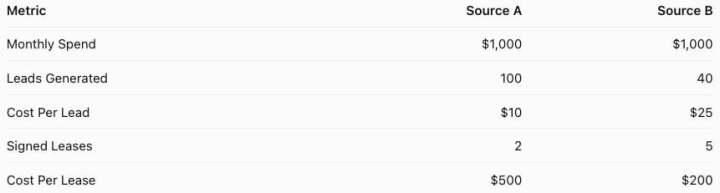
Illustrative example only; not actual RYSE property data.
At first glance, Source A appears more efficient because it generates leads at a lower cost.
However, Source B produces more than twice as many leases from the same investment.
This is why cost per lease, alongside lease quality and downstream performance, should play a central role in evaluating marketing effectiveness.
4. The Leasing Funnel Reveals Where Opportunities Are Lost
Marketing does not stop when a prospect submits an inquiry.
The journey from initial interest to signed lease includes several critical stages.

When conversion drops at a particular stage, it creates an opportunity for targeted improvement.
If prospects are not scheduling tours, follow-up speed or communication quality may be the issue.
If tours are not converting into applications, pricing, presentation, or the onsite experience may need attention.
If approved applications are not becoming signed leases, the application and lease execution process may require improvement.
Understanding these patterns allows operators to solve specific problems instead of simply spending more money to generate additional traffic.
5. Technology Is Changing How Marketing Performance Is Measured
Modern CRM platforms, AI-powered communication tools, and integrated reporting systems are giving multifamily operators greater visibility into the prospect journey.
When properly implemented, these technologies can help teams track response times, identify follow-up gaps, measure lead source performance, and evaluate leasing outcomes.
However, technology alone does not guarantee better results.
The real advantage comes from connecting the data, interpreting what it means, and using those insights to improve operations.
A sophisticated marketing strategy requires collaboration between marketing teams, onsite associates, regional leadership, and ownership.
6. Better Marketing Requires Better Alignment
One of the biggest challenges in multifamily marketing is treating advertising and onsite leasing as separate functions.
Marketing may be responsible for generating leads, while onsite teams are responsible for converting them.
But the two functions are inseparable.
A successful campaign can underperform if prospects receive delayed responses or inconsistent follow-up.
Likewise, an exceptional leasing team cannot overcome a lack of qualified demand indefinitely.
Strong management creates accountability across the entire prospect journey, ensuring marketing strategy and leasing execution support the same objectives.
7. The Goal Is Better Results, Not Bigger Reports
Modern multifamily marketing produces an enormous amount of data.
Impressions, clicks, engagement, website sessions, calls, emails, guest cards, tours, and applications can quickly overwhelm even experienced operators.
The solution is not necessarily more reporting.
It is better interpretation.
Owners should expect marketing reports to explain which channels are driving results, where opportunities exist, and how future investments should be prioritized.
A strong marketing strategy should continuously evolve based on measurable performance.
Marketing Should Be Accountable to Asset Performance
Generating interest is important.
Generating qualified demand that converts into leases is what creates value.
At RYSE Management, we believe effective multifamily marketing requires more than attractive campaigns and impressive traffic numbers. It requires strategic planning, operational alignment, technology, and a clear understanding of how marketing investments influence asset performance.
Because the goal is not simply to generate more leads.
It is to generate better outcomes.
Ready for a more strategic approach to multifamily marketing? Discover how RYSE Management connects marketing, technology, and operations to support stronger leasing performance.